- See it in two minutes
Live, healthy cells. On the robot you already run.
How levitation separates live cells from dead cells and debris without labels, beads or spins, and how the LeviCell 96 runs it on 96 samples at a time.

Want to see it on your samples?
Book a workflow review2:14 · Sound on · Captions built in · Open on YouTube
- New study: Discovery Life Sciences × Parse Biosciences
10× the usable data. 1/10th the cost. One 40-minute run.
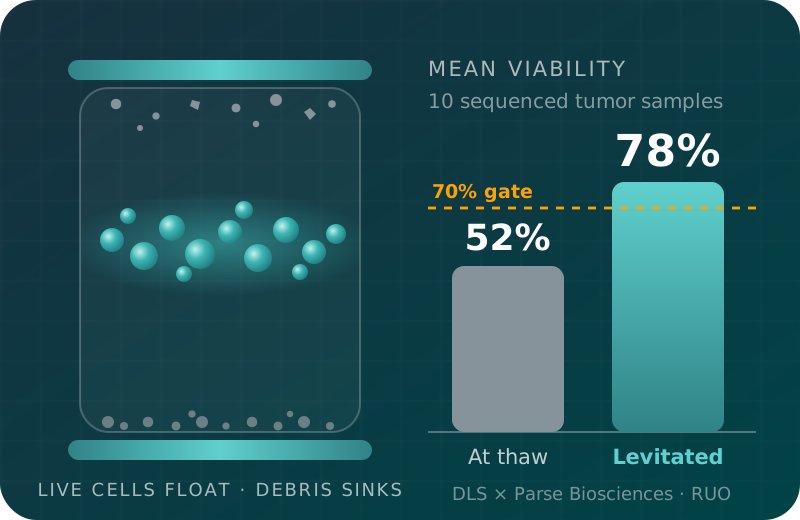
Discovery Life Sciences levitated 16 cryopreserved dissociated tumor samples, then sequenced them with Parse Evercode WT. Live cells floated into a band while dead cells and debris sank, with no labels, beads or centrifugation.
1 → 10
of 16 samples cleared the 70% viability gate
89%
of dead cells removed in a typical sample
6×
fewer doublets in Parse sequencing
- Choose your path
Start where your samples are.
Rescue precious samples.
Low-viability, low-input or irreplaceable samples, one at a time or twelve at a time, with LeviCell 1.0, EOS and 12.
Automate sample prep.
Put enrichment, washing and nuclei clean-up on the liquid handler you already run, 96 samples at a time, and image every well on the standalone LeviCell Insight.
Build datasets at scale.
Perturbation screens, cell atlases and large-model training sets in the thousands of samples, every one prepped the same way.
- Why LevitasBio
Better data, more samples, lower cost and hands off the pipette
Sample prep is where data quality is won or lost, and it is still the most manual step in the lab. Levitation Technology™ replaces centrifuges, filters, beads and labels with a gentle magnetic density field, so the step that once needed hands now runs on a robot.
Data quality
Over 95% viability, debris and dead cells removed, and no labels, pressure or shear that could alter expression states.
Throughput
96 samples in parallel on one array: 5 minutes hands-on, 40 minutes of levitation, 45 minutes from loading to enriched cells.
Cost per sample
About $10 per sample instead of more than $100, with fewer failed runs and repeats downstream.
Automation
A standard SBS footprint, scripted deck protocols, three hands-on steps and walkaway runs.
- One workflow
Every sample-prep step, on the robot deck
The LeviCell® 96 System brings the steps that usually happen on separate benches into one label-free, centrifuge-free workflow on standard SBS-compatible liquid handling.
- Cells: primary cells, PBMCs, dissociated tumors, adherent and suspension lines
- Nuclei: debris and aggregates cleaned up from nuclei preps, ready to load
- Organoids and spheroids: whole or dissociated
- Particles: from bacteria to large clusters, sorted by density
Enrich
Separate viable cells from dead cells and debris.
Wash
Buffer exchanges in the well, with no centrifuge spins.
Pellet
Levitation gathers viable cells into a tight pellet above dead cells and debris, with no centrifuge.
Image
LeviCell Insight, our standalone brightfield imager, images every well of the array at once in about five minutes. For the LeviCell 12 and 96.
Analyze
Check cell health, aggregation and purity in every well from the LeviCell Insight images before you commit downstream.
Collect
Pick the fraction of interest and leave the waste behind.
Pool
Combine wells or replicates to fit your study design.
Concentrate
Elute in small volumes, ready for loading.

Courtney Ward
Core Facility Manager
Queen's University Belfast
The LeviCell EOS system has been a key addition to our scRNA-seq workflow. It allows us to visually QC samples in detail ahead of loading on to the 10X Genomics Chromium X system. The data obtained indicates sample suitability for further analysis, preventing us from proceeding with sub-optimal samples and thus saving both our unit and our users significant time and money.

Nidal Karagic, PhD
Postdoctoral Researcher
Institute of Biotechnology, University of Helsinki
Thanks to the LeviCell system, our single cell experiments have seen a significant increase in viable cell recovery. Fragile cells are handled with care resulting in 2-3 times higher yields!

Greg Golden, PhD
Postdoctoral Researcher
University of Pennsylvania
The LeviCell EOS system allows our lab to process several low-viability samples simultaneously into high-viability samples, which is absolutely critical for single cell sequencing analyses. The LeviCell EOS system will increase our throughput and quality for rare and difficult samples.

Michelle Galeas-Peña, MD, PhD
Research Assistant Professor
Tulane University School of Medicine
The LeviCell 1.0 system is easy and intuitive to use, enabling us to enrich for precious viable cells from cell suspensions with viabilities below 40%, dissociated from frozen biobanked tissues for scRNA-seq.

Stefan Günther, PhD
Head of Next Gen Sequencing Facility
Max Planck Institute
We successfully integrated LevitasBio’s Levitation Technology into our workflows for a variety of single cell approaches. Experiments with very sensitive cell types, or samples that are not suitable for cell sorting, benefit from this gentle, fast method to exclude dead cells and debris.

- Built for automation
Drops into the automation you already run
The Selective Arrayed Levitation Technology (SALT™) array uses the SLAS/SBS 96-well footprint, so it fits a standard deck position next to your tips, plates and reagents.
- No centrifuge, filters, beads or microfluidics: fewer devices to integrate and fewer moving parts
- Scripted protocols: enrichment, wash and nuclei workflows run on the liquid handler
- 15,000 to 500,000 cells per well: from precious biopsies to bulk screening
- Same chemistry from 12 to 96: develop methods on the LeviCell 12, then scale up to the LeviCell 96 without re-optimizing


- Applications
Applied across your research needs

Viable Cell Enrichment
Rescue precious samples even at low viabilities and low quantities while simultaneously removing debris and contaminants.

Single-Cell Genomics
Obtain high quality cells and yield more cells, more sequencing data and more significant results.

Cancer Profiling
Unmask the true biology behind cancer by characterizing the cellular and molecular basis of tumors.

3D Cultures
Standardize organoid and spheroid workflows in 96-well format for reproducible screening, toxicity and disease modeling at scale.

Image-Based Sample QC
Image every well at once and check cell health, aggregation and purity before you sequence or screen.